

Why are your legs bigger than your upper body and painful? Discover lipedema symptoms, diagnosis issues in the USA, and effective treatment options available abroad.
If you’ve ever asked yourself:
You are not imagining it. And more importantly, it’s not your fault.
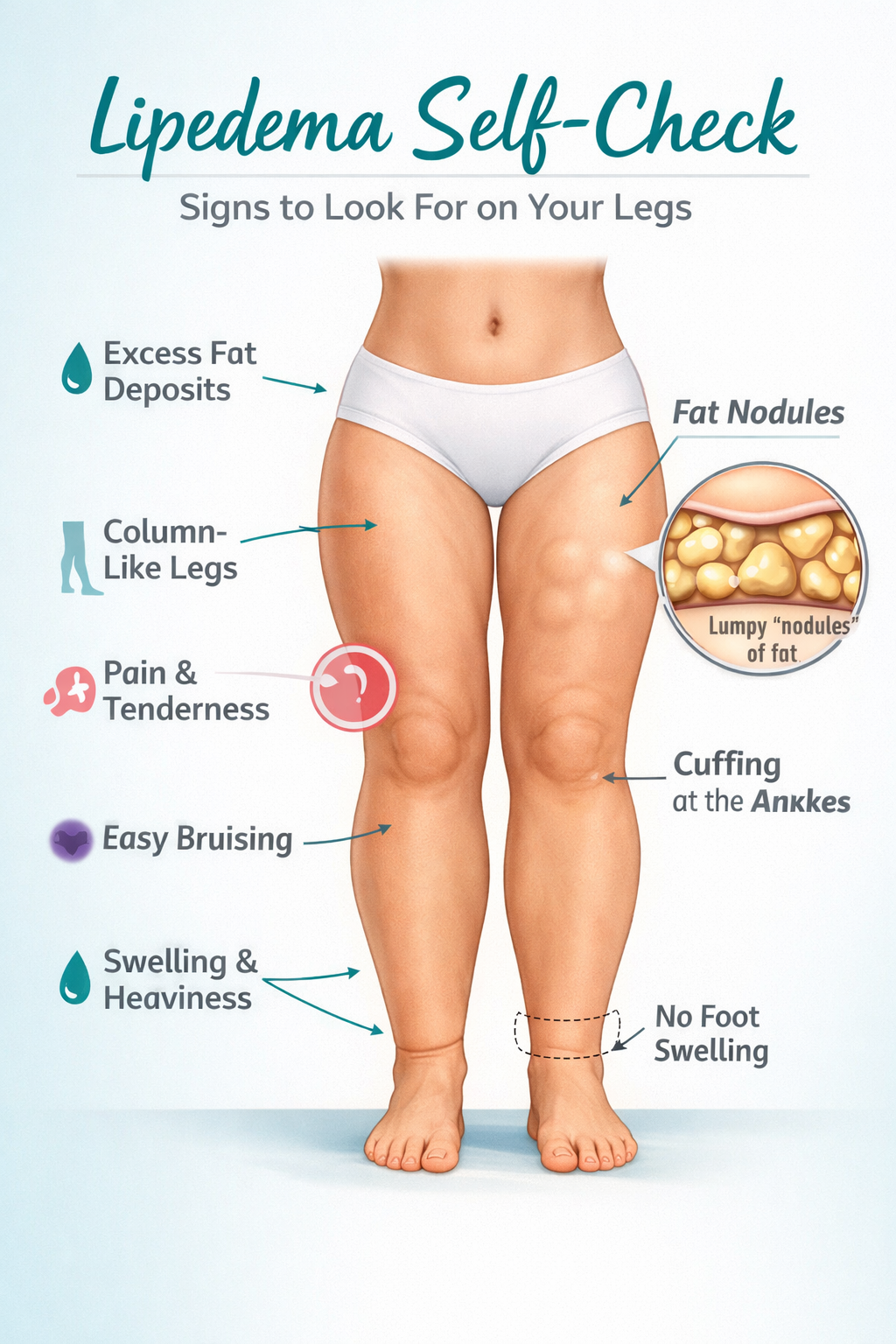
This condition is known medically as lipedema—a chronic disorder that causes abnormal fat accumulation, mainly in the legs, hips, and sometimes arms.
Unlike regular fat:
In the United States, lipedema remains widely underdiagnosed and misunderstood.
Most patients are told they simply need to lose weight—even when their symptoms clearly don’t match obesity.
This leads to years of frustration, including:
As a result, many women face:
This is where many patients reach a turning point.
Because lipedema is not just fat—it is a diseased fat tissue—traditional methods are not enough.
When women talk about “reduction surgery” for lipedema, they almost always mean a form of liposuction adapted to this condition. Ordinary cosmetic liposuction sculpts a silhouette. Here, the aim is different: to remove the pathological fat that causes pain, swelling and easy bruising, using fine cannulas and gentle techniques such as tumescent liposuction or water-assisted liposuction for lipedema, so that lymphatic and blood vessels are spared as much as possible.
Because lipedema fat is a diseased tissue, a good result is judged as much by how you feel as by how you look:
It is not a weight-loss operation, and it does not replace compression, lymphatic care and healthy habits, which remain part of long-term management. It is an option for women whose symptoms persist despite them.
Surgery is usually considered once a doctor familiar with lipedema has confirmed the diagnosis and symptoms continue despite conservative care. Your stage, the distribution of fat, your skin quality and your general health then shape the plan.
If you are pregnant, planning a pregnancy soon, or dealing with an untreated medical condition, the surgeon may advise waiting. This is something to raise at your first consultation.
Most patients wear a compression garment for several weeks, and bruising and swelling settle gradually. The contour keeps refining over the following months, so the final result is judged well after the operation, not on the day you go home.
Many women report less pain and heaviness afterwards, but results vary from one person to another and cannot be guaranteed. Fat removed from treated areas does not come back in the same way, yet lipedema is a chronic condition: it can still evolve in untreated areas, and weight gain can affect the outcome. That is why follow-up and healthy habits stay part of your care.
Costs for lipedema reduction surgery differ enormously from one country to another. Our lipedema surgery cost comparison between the USA, Canada, the UK and Tunisia sets typical price ranges side by side. And if you wonder who would operate on you, Dr Gam's training and techniques are detailed in his profile as a lipoedema specialist surgeon.
For international patients considering treatment abroad, Tunisia is one of the destinations where specialized lipedema surgery is available.
At Medespoir, lipedema procedures in Tunisia are performed by Dr Gam, whose approach combines several liposuction technologies, including VASER and Vibrofit, with radiofrequency.
The appropriate technique, the number of areas that can be treated and the treatment plan depend on the patient's clinical situation and should be determined during an individual medical assessment.
The objective is not simply to change body shape, but to determine whether a specialized surgical approach is appropriate for the patient's symptoms, tissue characteristics and overall medical situation.
In countries like Germany and Spain, specialized liposuction techniques have been developed specifically for lipedema.
These include:
These techniques aim to:
Your lipedema treatment is performed by Dr Gam, a surgeon known for his advanced approach to complex fat disorders.
He is currently the only surgeon in Tunisia—and one of the few worldwide—to combine multiple liposuction technologies with radiofrequency in a single protocol specifically adapted to lipedema patients.
This technique integrates VASER, Vibrofit and skin-tightening radiofrequency to remove pathological fat more effectively, improve body contour, and limit the risk of lipedema recurrence.
For many international patients, this approach offers a more complete solution compared to traditional staged procedures often performed in the United States.
In Tunisia, Dr Gam has developed a more global approach to lipedema treatment, combining several advanced technologies into one protocol.
This allows:
Unlike traditional approaches, this method treats lipedema as a global condition rather than isolated areas.

© 2025



 0033 (0)1 84 800
400
 +33 6 35 23 57 12

 +33 6 35 23 57 12
 Medespoir Canada :