Ozempic Face: The Hollywood Side Effect Nobody Signed Up For
At a Glance
- The Phenomenon: "Ozempic face" describes the gaunt, hollowed, and prematurely aged look linked to rapid weight loss from GLP-1 medications.
- The Stars: Rosie O'Donnell, Meghan Trainor, Robbie Williams, and Margaret Josephs have all been publicly linked to the look — some after confirming GLP-1 use.
- The Cause: Rapid depletion of facial fat pads combined with skin that cannot retract quickly enough. It is a volume problem and a laxity problem.
- The Fix: A deep plane facelift restores structural support, while eyelid surgery addresses the hollow, tired eye area that is often the most visible sign.
- The Timing: Surgery is not recommended until weight has been stable for at least 3 to 6 months.
[
Before / After — Robbie Williams and Ozempic Face
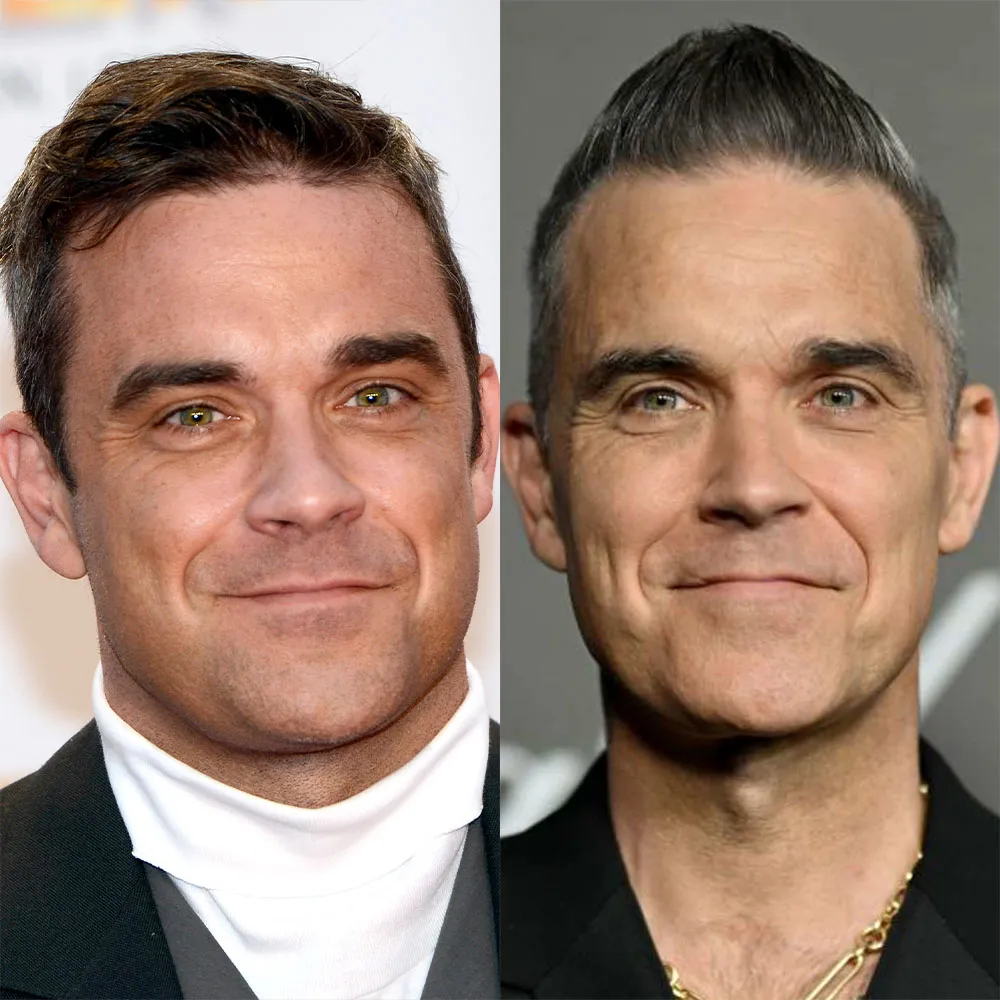
Losing weight is supposed to feel like a victory. But for a growing number of people — including some of the most photographed faces in the world — the scale goes down and the reflection in the mirror becomes a stranger.
The term "Ozempic face" has entered the cultural vocabulary to describe what happens when weight comes off faster than skin can adapt. The face deflates, the cheeks hollow, and the jawline that was once supported by fat now hangs with nowhere to go.
This is not a cosmetic failure. It is a biomechanical inevitability of rapid fat loss. And for many, the solution is not more weight loss — it is surgical restoration.
Which Stars Have Been Linked to "Ozempic Face"?
Some celebrities have confirmed their use of GLP-1 medications. Others have been the subject of widespread speculation. In every case, the visual signature is the same: midface volume loss, deepening nasolabial folds, and a look that reads as "tired" or "aged" regardless of the person's actual age.
| Celebrity | Context |
|---|---|
| Rosie O'Donnell | Used Mounjaro and lost around 60 lbs. Later underwent a lower deep plane facelift to address "melting" skin and facial laxity. |
| Meghan Trainor | Confirmed using the lowest-dose Mounjaro alongside diet and exercise. Frequently cited by surgeons as a prime example of the facial changes. |
| Robbie Williams | Spoke about serious health concerns after using weight-loss jabs. Widely referenced by experts as a high-profile case. |
| Margaret Josephs | Real Housewives star. One of the first to use GLP-1s; noticed facial sagging and later had cosmetic surgery on her nose. |
| Heather Gay | Confirmed Ozempic use in 2023, then switched to Mounjaro. Lost 30 lbs over three years with visible volume loss. |
| Charlize Theron | Widely speculated on after a 2026 appearance with a gaunt face. Responded humorously without confirming or denying GLP-1 use. |
| Olivia Wilde | Medical commentators analyzed her red-carpet appearance as a textbook example of "Ozempic face." |
| Gina-Lisa Lohfink | German model. Openly used Ozempic and actively sought aesthetic treatment for facial volume loss, planning collagen boosters and fillers. |
Why the Face Changes: It Is Not Just Fat
"Ozempic face" is not simply a matter of being thinner. The face has distinct fat compartments — in the cheeks, temples, and under the eyes — that provide structural support. When these deflate rapidly, three things happen at once:
- Volume loss: The midface hollows, the temples sink, and the area under the eyes becomes dark and recessed.
- Skin laxity: The skin that was once stretched over fuller contours cannot retract quickly enough, leading to jowls, marionette lines, and neck sagging.
- Structural descent: Without the fat pads to hold it up, the soft tissue of the face drops, flattening the midface and weighing down the lower face.
This is why fillers alone often fail. Adding volume to a face that has lost its structural support is like inflating a deflated balloon — the shape is still wrong. The most effective surgical approach combines lifting with volumizing.
The Surgical Solution: Deep Plane Facelift and Eyelid Surgery
Deep Plane Facelift: Restoring Structure, Not Just Skin
For patients who have lost significant weight and see sagging along the jawline and neck, a deep plane facelift is often the most comprehensive solution. Unlike older techniques that pull only the skin, the deep plane approach repositions the deeper structural layers of the face — the SMAS and underlying tissues — to restore the midface, jawline, and neck as a unified whole.
This is particularly important for post-weight-loss patients because the problem is not just loose skin. It is the descent of tissue that once had fat to support it. A deep plane facelift addresses both the descent and the loss of structural support simultaneously, without the "pulled" look associated with superficial tightening.
Eyelid Surgery: The Eyes Give It Away
If there is one area where "Ozempic face" is most visible, it is the eyes. Rapid weight loss hollows the lower lids, creating deep tear troughs and a perpetually tired appearance. Upper lid skin can become lax and heavy.
Eyelid surgery (blepharoplasty) can remove excess upper lid skin and reposition or remove lower lid fat to refresh the eye area without changing the fundamental character of the eyes. For post-weight-loss patients, it is often performed alongside a facelift to achieve a balanced, natural result.
Timing Matters: When Should You Consider Surgery?
One of the most common mistakes is rushing into surgery while weight is still fluctuating. Surgeons generally recommend waiting until your weight has been stable for at least 3 to 6 months. There are two reasons for this:
- Surgical predictability: A face that is still losing volume will continue to change after surgery, potentially undoing the result.
- Anesthesia safety: GLP-1 medications slow stomach emptying, which can increase the risk of aspiration during general anesthesia. Your surgical team will advise you on when to pause the medication before surgery.
Once your weight is stable and your metabolic health is optimized, facial surgery can deliver results that no injectable can replicate: a face that looks like you, not like a thinner version of someone else.